


Download Rabby Wallet: a practical case for DeFi power users who won’t click blind
Imagine you’re on a Friday night, about to execute a leveraged trade on a new perpetual DEX that promises better slippage than your usual route. The interface looks polished, the APY is inflated, and the approval prompt pops up in your browser extension. At that moment you have three options: blindly confirm, pause and research the contract, or use a wallet that gives you more than a colored modal and hope. This article walks through the last option—why a simulator-first, multi-chain wallet like Rabby can change the decision calculus for serious DeFi users in the US who routinely interact with new contracts, cross-chain bridges, and complex approval flows.
I’ll use a concrete scenario—entering and exiting a layered position across Ethereum and Arbitrum while composing approvals for a liquidity pool—to show mechanism-level differences among wallets, explain where Rabby’s features matter, and point out limits that still require human judgment or institutional controls. The goal is not marketing: it’s to map when the wallet materially reduces risk, where it does not, and how to adopt it safely in an operational workflow that includes hardware wallets and multi-sig for higher-stakes funds.
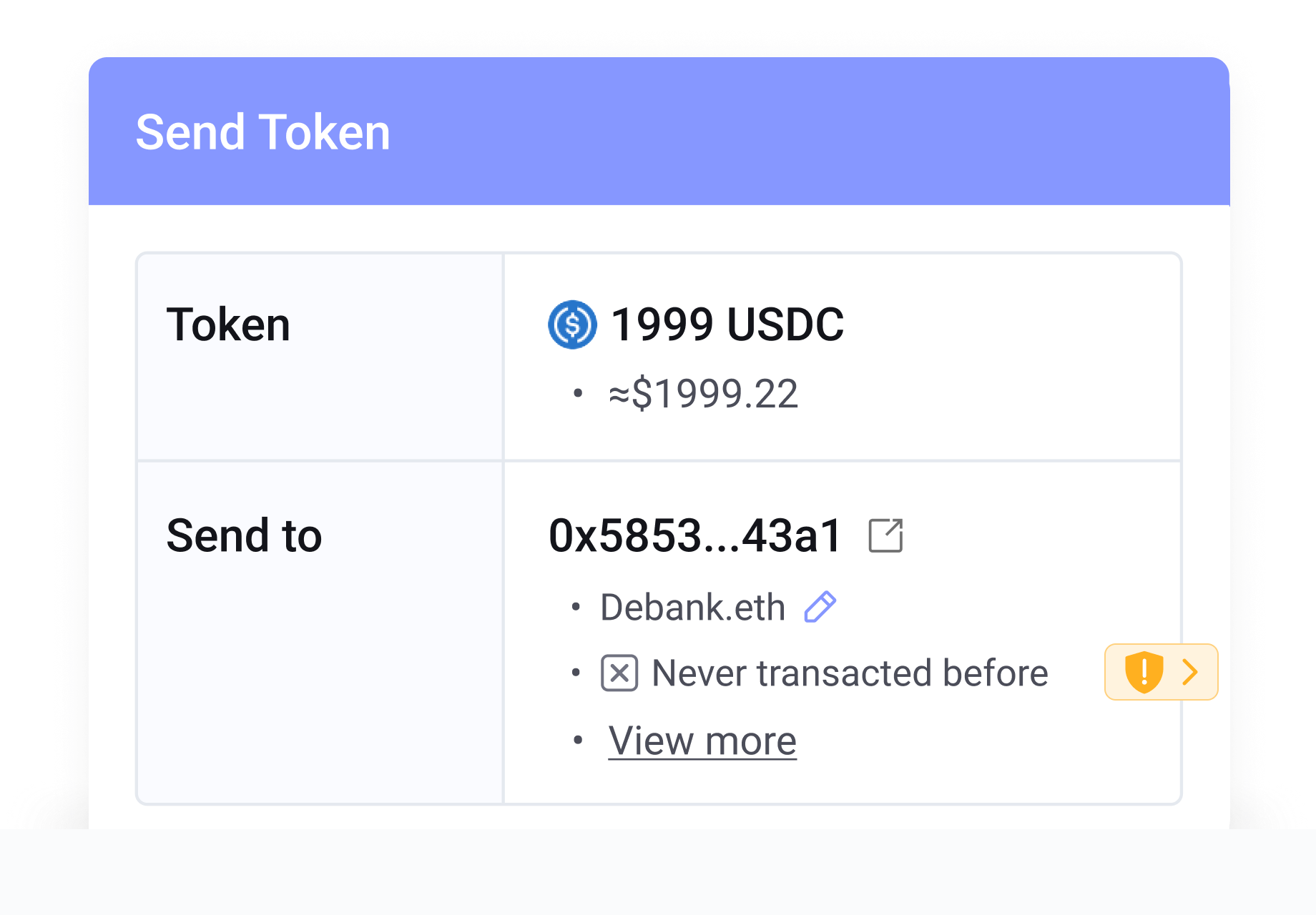
How Rabby changes the pre-signing decision
Most mainstream browser wallets provide a confirmation dialog: amounts, gas, and an opaque “Approve” or “Confirm” button. That model assumes the user either understands the contract payload or will inspect raw data—an expectation that fails often in practice. Rabby inserts two mechanistic tools into the signing path that alter how the user reasons about safety.
First, transaction simulation. Before sending a signature, Rabby simulates the transaction and displays estimated token balance changes and explicit fee math. That matters mechanistically because it exposes the expected state change that the smart contract will cause, instead of leaving the user to infer effects from encoded calldata. For the scenario above—entering a synthetic position that mints tokens and grants approvals—seeing the simulated token deltas lets you confirm the minting amounts, unexpected drains, or hidden fee-on-transfer mechanics before you sign.
Second, pre-transaction risk scanning. Rabby’s security engine flags known hacked contracts, suspicious approval requests, and non-existent recipient addresses. This is not oracle-proof safety—it’s a probabilistic screening layer that reduces false negatives for previously observed malicious patterns. In other words, it helps catch known-bad behaviors but does not guarantee protection from zero-day exploits or freshly deployed attacker contracts that mimic legitimate ones.
Where Rabby fits in a DeFi operational stack
Rabby is a browser extension, mobile app, and desktop client with hardware wallet compatibility and multi-sig integrations. For a US-based DeFi power user who executes frequent trades and composes complex transactions, it sits between the wallet seed/hardware layer and the dApp layer. Practically that means you can: import a hardware wallet like Ledger, use Rabby as the signing UI, and benefit from simulation and approval revocation without moving custody away from the ledger device.
That integration model supports several operational templates. At the solo-trader level, enable the hardware wallet, use Rabby for automatic network switching across Ethereum and rollups, and treat the simulation view as a mandatory checkpoint before confirming approvals. For small teams or treasury-grade setups, Rabby’s compatibility with Gnosis Safe and institutional custodians like Fireblocks lets you retain multi-sig controls while using the wallet’s UX benefits. The trade-off is process complexity—adding simulation checks can slow down high-frequency flows and requires a disciplined mental model to interpret simulation outputs correctly.
One practical heuristic: treat simulation as a filter, not an oracle. If Rabby shows an unexpected token outflow or a suspicious spender approval, stop and investigate. If simulation matches your expectation—exact token delta and fee—then proceed. This reduces cognitive load compared with manual calldata parsing and is particularly useful when interacting with freshly deployed contracts or cross-chain bridges where UI labels are inconsistent.
Comparative trade-offs and where Rabby does not replace other controls
Rabby competes with wallets like MetaMask, Trust Wallet, and Coinbase Wallet. Its distinguishing mechanisms are transaction simulation and automatic network switching. Those are practical advantages: the former reduces “blind signing” errors; the latter prevents the common mishap of sending transactions on the wrong chain. However, there are trade-offs and limits to be explicit about.
First, Rabby does not include a built-in fiat on-ramp or native in-wallet staking at present. So if you want to buy crypto with a US bank card inside the wallet, you will still need an external service. Second, simulation and risk scanning reduce but do not eliminate risk: they cannot predict logic bugs in complex composable interactions, nor can they see malicious behavior in smart contracts that emulate benign ones and have no historical footprint. Third, past incidents matter: Rabby’s Swap contract was exploited in 2022 for approximately $190,000. The response—freezing the contract, compensating users, and strengthening audits—demonstrates operational learning, but it also highlights that wallets tied to active DeFi features inherit protocol risk when they host integrated services.
Finally, UX trade-offs exist. Automatic network switching is convenient but can lead to surprise if you regularly test across networks or maintain multiple accounts per network. Rabby mitigates this with clear indicators, but users transitioning from manual switching must recalibrate expectations.
Downloading Rabby and integrating safely
If you decide the simulation-first model reduces your personal failure modes, download points matter. Use official distribution channels: the extension for Chromium browsers, the desktop client for macOS/Windows, or the mobile app stores. To connect to hardware wallets, follow device vendor guidance and always verify the device’s display for transaction details—hardware wallets remain the highest-utility defense against seed compromise.
For convenience, here is a vetted resource to start from: rabby. Use that link to verify installation steps and platform compatibility before importing seeds or connecting hardware devices. After installation, set up a distinct operational account for high-frequency trading and another for longer-term holdings; this compartmentalization reduces blast radius when an approval goes wrong.
One setup pattern I recommend: (1) Keep your long-term funds in a hardware-backed multi-sig (Gnosis Safe, custodial services for institutional funds). (2) Use Rabby + hardware wallet for tactical positions and active DeFi. (3) Treat the built-in approval revocation tool as a weekly hygiene item—revoke stale approvals for contracts you no longer use. This balances speed and safety.
Mechanisms to watch and near-term signals
Where should a risk-conscious user look for signals that change the calculus? Monitor three types of signals: (1) security audits and third-party audit results for any integrated Rabby feature or swap contract, (2) changes in the open-source repository or dependency updates that could introduce supply-chain risk, and (3) on-chain anomalies such as unusual approval patterns or large outflows from known contracts. Improvements in simulation accuracy and broader on-chain heuristics would materially lower residual risk; conversely, evidence of frequent false negatives in the risk engine would demand a reversion to stricter manual review.
Also watch the adoption of multi-sig and custodial integrations among institutional players. If Rabby deepens integrations with enterprise custody, it could shift from a power-user tool to a workflow standard for smaller treasury teams—conditional on audits and regulatory clarity in the US about custody interfaces.
FAQ
Is Rabby safer than MetaMask?
Safer is context-dependent. Rabby adds transaction simulation and risk scanning that reduce blind-signing errors, which are common user-originated failures. MetaMask is broadly compatible and widely audited. If your primary failure mode is signing confusing calldata or approving too-broad spenders, Rabby’s simulation gives a tangible advantage. If your risk concerns are seed compromise or supply-chain attacks, hardware wallets and multi-sig matter more than the particular extension UI.
Can Rabby prevent smart contract exploits?
No. Rabby can flag known-bad contracts and simulate state changes to reveal unexpected token deltas, but it cannot detect zero-day vulnerabilities or logic bugs in a contract’s code. Simulation exposes intended state changes based on current chain state; it does not formally verify contract correctness. For high-value transactions, pair Rabby’s tools with external audits, manual code review where possible, and conservative approval policies.
Does Rabby work with Ledger and other hardware wallets?
Yes. Rabby integrates with major hardware wallets like Ledger, Trezor, Keystone, and others. The recommended best practice is to keep the hardware wallet as the sole signer for cold funds; use Rabby as the UX layer for simulation and approval management while confirming critical details on the hardware device display.
How does automatic network switching affect cross-chain work?
Automatic network switching reduces user error when opening dApps on different EVM chains by switching the extension to the correct chain. This saves time and prevents sending transactions on the wrong network, but it requires attention if you deliberately operate on multiple chains simultaneously; always double-check the chain indicator and asset balances before signing.
Bottom line: Rabby is not a panacea, but it addresses one of the most consequential user failure modes in DeFi—blind signing—by changing the information set available at the point of consent. For US-based power users who trade across rollups, rely on hardware wallets, and need multi-sig compatibility, Rabby offers a pragmatic set of features that fit into a layered security posture. The remaining gaps—on-ramps, in-wallet staking, and absolute protection from novel exploits—are operational constraints you must handle with complementary tools and process controls.
Adopt the simulation as a discipline, keep high-value funds in custody solutions or multi-sig, and treat approval revocation as routine hygiene. That combination turns Rabby from a nicer UI into a measurable reduction in the most common class of human error when interacting with composable DeFi.

Leave a Reply